Support & Info
Bug Tracking: Bugs & FeaturesMailing List: Info
Git Repository: github (sourceforge - deprecated)
License: 3-clause BSD
IRC: #libevent on OFTC
Happy Hacking
You can make Libevent developers happy by reducing our wishlists!Nick's list – Niels's list

libevent is meant to replace the event loop found in event driven network servers. An application just needs to call event_dispatch() and then add or remove events dynamically without having to change the event loop.
Currently, libevent supports /dev/poll, kqueue(2), event ports, POSIX select(2), Windows select(), poll(2), and epoll(4). The internal event mechanism is completely independent of the exposed event API, and a simple update of libevent can provide new functionality without having to redesign the applications. As a result, Libevent allows for portable application development and provides the most scalable event notification mechanism available on an operating system. Libevent can also be used for multi-threaded applications, either by isolating each event_base so that only a single thread accesses it, or by locked access to a single shared event_base. Libevent should compile on Linux, *BSD, Mac OS X, Solaris, Windows, and more.
Libevent additionally provides a sophisticated framework for buffered network IO, with support for sockets, filters, rate-limiting, SSL, zero-copy file transmission, and IOCP. Libevent includes support for several useful protocols, including DNS, HTTP, and a minimal RPC framework.
More information about event notification mechanisms for network servers can be found on Dan Kegel's "The C10K problem" web page.
A mailing list for libevent is now available. Libevent is maintained by Nick Mathewson, Azat Khuzhin and Niels Provos.
Documentation
Book: Programming with Libevent.Reference: 1.4.x-stable 2.0.x-stable 2.1.x-stable master
ABI/API compatibility report: releases master
What's new in: 2.0.x-stable 2.1.x-alpha.
Download–Stable releases
These are the ones you probably want for software development, unless you like to track the latest development versions and report bugs in them.
- libevent-2.1.12-stable.tar.gz [GPG Sig] ChangeLog
PR
Released 2020-07-05 - libevent-2.1.11-stable.tar.gz [GPG Sig] ChangeLog
Released 2019-08-01 (ABI changed) - libevent-2.1.10-stable.tar.gz [GPG Sig] ChangeLog
Released 2019-05-26 -
libevent-2.1.8-stable.tar.gz [GPG Sig] ChangeLog
Released 2017-01-22- Changelog to follow
-
libevent-2.0.22-stable.tar.gz [GPG Sig] ChangeLog
Released 2014-01-05- Changelog to follow
-
libevent-2.0.21-stable.tar.gz [GPG Sig] ChangeLog
Released 2012-11-18- Several SSL correctness and performance fixes.
- Build fixes for mingw64
- Avoid a few resource leaks
- and more...
-
libevent-2.0.20-stable.tar.gz [GPG Sig] ChangeLog
Released 2012-08-23- Fix a crash on windows.
- Make event_pending() threadsafe.
- Another SSL callback behavior fixes
- Avoid an evdns segfault (Greg Hazel)
- and more...
-
libevent-1.4.15-stable.tar.gz ChangeLog
Released 2015-01-05- Changelog to follow
-
libevent-1.4.14b-stable.tar.gz [GPG Sig] ChangeLog
Released 2010-06-07- Backport evbuffer_readln()
- Fix a crash when reading badly formatted resolve.conf (Yasuoka Masahiko)
- Make evutil_make_socket_nonblocking() leave any other flags alone (Jardel Weyrich)
- Adjusted fcntl() retval comparison on evutil_make_socket_nonblocking() (Jardel Weyrich)
- Re-add event_siglcb; some old code _was_ still using it. :(
- Make Libevent 1.4 build on win32 with Unicode enabled. (Brodie Thiesfield)
- Distribute nmake makefile for 1.4
- Define _REENTRANT as needed on Solaris, elsewhere (6cbea13)
- Other bugfixes for http, memory management, and cleanup.
Download release candidates
This is a release candidate. If you find any bugs, please let us know!
-
libevent-2.1.7-rc.tar.gz ChangeLog
Released 2016-11-05- Changelog to follow.
Download–Alpha releases
This is alpha code. If you find any bugs, please let us know!
- libevent-2.2.1-alpha-dev.tar.gz [GPG Sig] ChangeLog
Released 2023-05-21 - libevent-2.1.9-beta.tar.gz [GPG Sig] ChangeLog
Released 2019-02-10 - libevent-2.0.23-beta.tar.gz [GPG Sig] ChangeLog
Released 2019-01-20 -
libevent-2.1.6-beta.tar.gz ChangeLog
Released 2016-08-27- Changelog to follow.
-
libevent-2.1.5-beta.tar.gz [GPG Sig] ChangeLog
Released 2015-01-05- Changelog to follow.
-
libevent-2.1.4-alpha.tar.gz [GPG Sig] ChangeLog
Released 2014-03-21- Several new utility APIs in libevent core, bufferevents, and evhttp.
- Detect closes early with EPOLLRDHUP.
- (Optional) support for buildint with cmake.
- Bugfixes too numerous to mention.
- and much more...
-
libevent-2.1.3-alpha.tar.gz [GPG Sig] ChangeLog
Released 2013-05-01- New finalization API with fix for bufferevent deadlock issue.
- New evdns and evhttp option.
- Several new unit tests.
- Bugfixes and portability fixes and build fixes too numerous to mention.
- and much more...
-
libevent-2.1.2-alpha.tar.gz [GPG Sig] ChangeLog
Released 2012-11-18- Various new functions in the core, evbuffer, and bufferevent APIs
- Even more backends can now use portable monotonic timers.
- Updated autotools build infrastructure for faster builds.
- More reliable unit tests
- Internal event-callback interface now refactored for flexibility and performance
- Faster notification with kqueue, faster/more precise timers on Linux
- Numerous small performance improvements and data structure tweaks throughout the codebase
- Various bugfixes against 2.1.1-alpha
- and much more...
-
libevent-2.1.1-alpha.tar.gz [GPG Sig] ChangeLog
Released 2012-04-03- First alpha release in the 2.1.x series.
- Useful features for controlling the event loop and avoiding priority inversion
- New debugging features.
- New evbuffer functionality, including an improved sendfile/mmap wrapper, the ability to add one evbuffer to another, and more ways to avoid needless copies.
- Numerous small performance improvements and data structure tweaks throughout the codebase.
- and much more...
Older Releases
Libevent has been released under a 3-clause BSD license. Information on public git access.
Benchmark
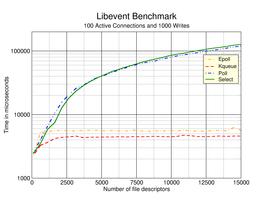
Performance comparison using different event notification mechansims in Libevent. We declare interest in a large number of connections of which most are cold and only a few are active.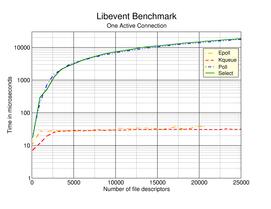 |
 |
|
| The benchmark measures how long it takes to serve one active connection and exposes scalability issues of traditional interfaces like select or poll. | The benchmark measures how long it takes to serve one hundred active connections that chain writes to new connections until thousand writes and reads have happened. It exercises the event loop several times. |
Programs using libevent
The usefulness of libevent API is demonstrated by the following applications:- Chromium – Google's open-source web browser (uses Libevent)
- Memcached – a high-performance, distributed memory object caching system
- Transmission – a fast, easy, and free BitTorrent client
- NTP – the network time protocol that makes your clock right (uses Libevent in SNTP)
- tmux – A clean, modern, BSD-licensed terminal multiplexer, similar to GNU screen
- Tor – an anonymous Internet communication system.
- libevhtp – A fast and flexible replacement for libevent's http client/server API
- Prosody – A Jabber/XMPP server written in Lua
- PgBouncer – Lightweight connection pooler for PostgreSQL
- redsocks – a simple transparent TCP -> Socks5/HTTPS proxy daemon.
- Vomit – Voice Over Misconfigured Internet Telephones
- Crawl – A Small and Efficient HTTP Crawler
- Libio – an input/output abstraction library
- Honeyd – a virtual honeynet daemon – can be used to fight Internet worms.
- Fragroute – an IDS testing tool
- Nylon – nested proxy server
- Disconcert – a Distributed Computing Framework for Loosely-Coupled Workstations.
- Trickle – a lightweight userspace bandwidth shaper.
- watchcatd – software watchdog designed to take actions not as drastic as the usual solutions, which reset the machine.
- ScanSSH – a fast SSH server and open proxy scanner.
- Nttlscan – a network topology scanner for Honeyd.
- NetChat – a combination of netcat and ppp's chat.
- Io – a small programming language; uses libevent for network communication.
- Systrace – a system call sandbox.
- SpyBye – detect malware on web pages.
- GreenSQL – an SQL database firewall.
- dnsscan – a fast scanner for identifying open recursive dns resolvers
- Kargo Event – a PHP extension for libevent.
- Scytale – a database encryption tool.
- Coturn – Free open source implementation of TURN and STUN Server.